
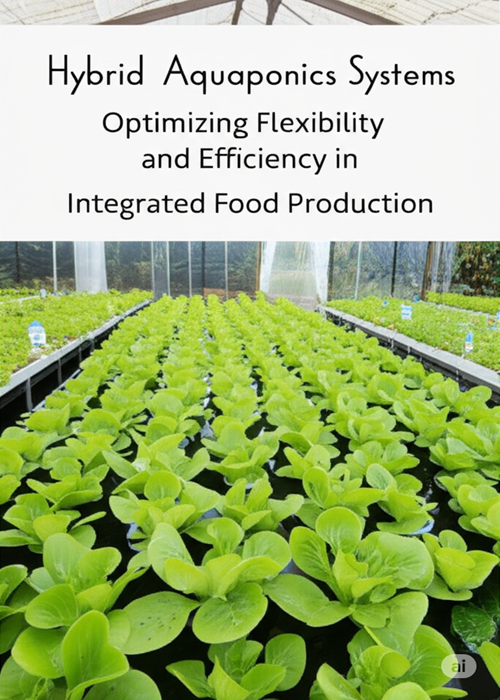
Optimizing Flexibility and Efficiency in Integrated Food Production
Hybrid aquaponics systems combine multiple cultivation techniques to create adaptable, high-yield ecosystems that transcend the limitations of single-method approaches. By integrating media beds, nutrient film technique (NFT), and deep water culture (DWC), these systems achieve superior nutrient management, risk mitigation, and crop diversification.
Hybrid configurations enable growers to tailor environments for specific plant-fish combinations while maintaining system stability through redundant biological and mechanical filtration.
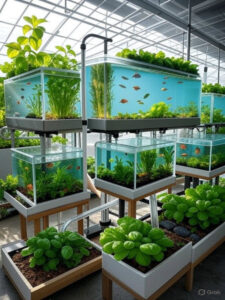
Hybrid System Configurations and Component Synergy
| Configuration | Core Components | Best Applications | Yield Increase vs. Single-Loop |
| Media-NFT Hybrid | Clay pebbles, NFT channels | Leafy greens, herbs | 35–40% |
| Raft-Media Cascade | DWC rafts, gravel beds | Tomatoes, cucumbers | 50–55% |
| Decoupled Multi-Loop | Separate fish/plant reservoirs | Commercial operations | 60–70% |
| Vertical Hybrid | Stacked towers, media beds | Urban micro-farms | 45–50% |
Advantages of Hybrid System Architecture
Customized Nutrient Delivery
Hybrid systems allow precise control over nutrient flows by combining media bed biofiltration with NFT’s targeted delivery. Media beds (clay pebbles or gravel) host nitrifying bacteria that convert 85–90% of fish ammonia into nitrates, while NFT channels direct these nutrients to plant roots at optimized flow rates (1–2 L/min for leafy greens). This dual-phase approach prevents nutrient lockout common in single-loop systems9.
Risk Mitigation Through Decoupling
Decoupled configurations separate aquaculture and hydroponic components, enabling independent management of fish and plant environments. Operators can adjust fish tank pH (7.0–7.5) and hydroponic pH (5.8–6.2) simultaneously—a critical advantage for sensitive crops like strawberries. During disease outbreaks, water circulation can be halted without crashing the entire system, reducing stock losses by up to 70%.
Space and Resource Efficiency
Vertical hybrid systems stack media beds above DWC rafts, producing 18–22 plants/ft² compared to 4–6 plants/ft² in horizontal setups6. Solar-powered airlift pumps reduce energy use by 40% compared to conventional submersibles, while cascading water flow between tiers cuts irrigation needs by 30%.
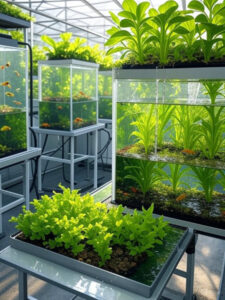
Hybrid System Design Principles
Component Selection Guidelines
- Biofilters: Use moving bed bioreactors (MBBR) with 35–45% K1 media fill for ammonia oxidation rates of 1.2–1.8 g/m³/day
- Grow Channels: Combine 4″ PVC NFT (slope 1:30) with 12″ media beds for root support in fruiting crops
- Pumps: Size pumps to handle 1.5x system volume/hour with 15–20% head pressure buffer
- Water Chemistry Balancing
| Parameter | Fish Loop Target | Plant Loop Target | Adjustment Method |
| pH | 7.0–7.5 | 5.8–6.2 | CO² injection (plants), aeration (fish) |
| Nitrates | <100 ppm | 30–150 ppm | Decoupled loop flushing |
| Dissolved Oxygen | 6–8 mg/L | 4–6 mg/L | Venturi injectors, surface agitators |
Operational Protocols for Peak Performance
Automation Integration
-
- Sensor Networks: Install ORP (450–500 mV) and EC (0.8–1.2 mS/cm) sensors with IoT controllers
- Flow Control: Use PWM-controlled pumps to maintain NFT flow rates within ±5% variance
- Backup Systems: Implement battery-powered air pumps (minimum 6-hour runtime) for power outages
Crop Rotation Strategy
-
- Phase 1 (Weeks 1–4): Fast-growing greens (lettuce, basil) in NFT
- Phase 2 (Weeks 5–8): Fruiting crops (peppers, strawberries) in media beds
- Phase 3 (Weeks 9–12): Heavy feeders (tomatoes, cucumbers) in DWC with supplemental Fe/Zn
Sustainability Metrics and ROI
-
- Water Use: 94–97% less than traditional agriculture (0.8–1.2 L/kg produce)
- Energy Efficiency: 0.25–0.4 kWh/kg combined fish/plant yield
- Nutrient Recovery: 85–90% nitrogen reuse through mineralization tanks
- Payback Period: 3–4 years for commercial systems via dual income streams (fish + premium produce)
Troubleshooting Hybrid System Challenges
| Symptom | Root Cause | Corrective Action |
| Leaf chlorosis in NFT | Fe/Mn deficiency | Inject chelated micronutrients (0.5 ppm) into plant loop |
| Fish gasping at surface | Overstocked media beds | Flush media with H²O² (3% solution), reduce feed by 25% |
| Uneven vertical growth | Light stratification | Install supplemental LED bars (450–660 nm) between tiers |
FAQ: Optimizing Hybrid Operations
Q: Can I transition an existing single-loop system to hybrid?
A: Yes—retrofit by adding a mineralization tank and separate plant reservoir. Expect 6–8 week stabilization phase.
Q: What fish/plant pairs work best in decoupled systems?
A: Tilapia (26–30°C) with tomatoes/peppers (EC 2.4–3.0 mS/cm) or trout (14–18°C) with leafy greens (EC 0.8–1.2).
Q: How to size a hybrid system for 100 kg/week production?
A: Use 3,000L fish tank (1 kg/m³ density), 40m² NFT/Media grow area, 500W solar array.
Wrap-Up
Hybrid aquaponics represents the pinnacle of controlled environment agriculture, merging biological resilience with engineering precision. By adopting modular design principles and advanced automation, growers can achieve unprecedented productivity across diverse climates and market demands. As food security challenges intensify, these systems offer a scalable blueprint for sustainable protein and vegetable production—transforming waste streams into agricultural assets through circular ecological design.